















The Supreme Court's 6-3 decision upholding birthright citizenship, based on the interpretation of the 14th Amendment's Citizenship Clause, is legally flawed and a 'legal abomination.' The majority's view that 'subject to the jurisdiction thereof' is largely superfluous, meaning nearly all individuals born in the U.S. are citizens, is a misinterpretation of history and law. This ruling effectively grants immunity from deportation to the parents of U.S.-born children of undocumented immigrants, creating a significant policy problem.
Congressional Action: Shaping Immigration History
Ben Shapiro details key congressional actions that have shaped U.S. immigration policy, including the Chinese Exclusion Act of 1882, the Immigration Act of 1917, the Emergency Quota Act of 1921, and the National Origins Act of 1924. These laws progressively restricted immigration, particularly from Asia and Southern/Eastern Europe. The most significant shift, however, came with the 1965 Immigration and Nationality Act, which repealed the quota system and opened the doors to increased immigration from Asia, Africa, and Latin America, fundamentally altering the demographic landscape.
Judicial Roadblocks to Enforcement
Judicial rulings, such as Arizona v. United States (2012), have severely hampered the ability of states and federal authorities to enforce immigration laws. The Supreme Court's decision effectively nullified state laws aimed at immigration enforcement, creating a situation where states can ignore federal law by declaring themselves 'sanctuary states,' but cannot actively enforce federal statutes. This judicial interpretation, according to the speaker, makes it nearly impossible to manage immigration when a Democrat is in office.
Chief Justice Roberts' majority opinion interprets the 14th Amendment's citizenship clause as incorporating the English common law rule of birthright citizenship, meaning anyone born on U.S. soil is a citizen. This interpretation is rooted in a historical narrative starting from British common law, through the Reconstruction era, and culminating in the Wong Kim Ark case, asserting that the phrase 'subject to the jurisdiction thereof' did not exclude children of temporary visitors. The opinion concludes that this broad interpretation has been consistently applied for over a century, solidifying birthright citizenship for nearly all children born in the U.S. This broad interpretation is the bedrock of the court's decision to uphold birthright citizenship.
Kavanaugh on Roundup: Federal Preemption Reigns
Justice Kavanaugh, writing for the majority in Monsanto v. Durnell, ruled that federal law preempts state-level lawsuits regarding warning labels on Roundup. He stated that because the EPA has concluded glyphosate is not likely to cause cancer, it has not required a cancer warning. Therefore, state claims demanding such warnings are preempted, preventing the destruction of industries by conflicting state mandates. The decision hinges on federal regulatory authority over product labeling.
Campaign Finance Loosened: Shapiro's Take
The Supreme Court's decision on campaign finance, specifically regarding limits on party expenditures coordinated with candidates, essentially frees up more money in politics. The commentator argues that campaign finance regulations are inherently flawed and often circumvented, suggesting they should be eliminated entirely.
The left's increasing aversion to the American flag is not merely a political stance but a symptom of a deeper rejection of the nation's foundational principles, which Shapiro argues are intrinsically linked to biblical values. He contends that this rejection allows for the adoption of alternative, often contradictory, symbols and ideologies.
The 'Palestine-Trans Flag' as an Antithesis
Shapiro presents a hybrid Palestine-trans flag as the antithesis of the American flag and its associated values. He argues that this symbol represents a radical ideology opposed to the principles of America, linking it to figures who, in his view, despise the nation and its foundations.
Jenkins: The Communist Mime's Goal
Ben Shapiro introduces David Jenkins, a member of the Democratic Socialists of America (DSA), framing him as a 'mime' whose ultimate goal is communism. Jenkins is quoted advocating for the disbandment of the NYPD's Strategic Response Group and diverting funds to public services, running under a 'libertarian socialist caucus.' Shapiro mocks Jenkins's background as a mime and his political aspirations, portraying the DSA as a collection of 'useless' individuals seeking power.
Ben Shapiro argues that the Democratic Socialists of America (DSA) and their allies are forming a 'Hate America Coalition' that is gaining significant traction, particularly among young people. He posits that this anti-American sentiment is not a bug but a feature of their strategy to win elections, evolving from the 'Obama Coalition' to the 'Coalition of the Oppressed' and now the 'Anti-Trump Coalition.' Shapiro asserts that this movement despises America and aims to fundamentally alter its systems.
The Demographic of DSA Support
Ben Shapiro contends that DSA candidates win primaries not due to affordability platforms, but because they appeal to a specific demographic: young, white, college-educated voters. He contrasts this with lower-income and minority areas, which he claims tend to support more moderate candidates. Shapiro cites poll data showing that while DSA support is low among older demographics, it is significant among 18-29 year olds, forming a core of the 'Hate America Coalition.'
DSA's Radical Platform
Shapiro outlines the DSA's platform, which includes abolishing the Senate, replacing the president and Supreme Court with Congress-controlled bodies, defunding the military, abolishing prisons, supporting Palestine, ending sanctions on Cuba, Venezuela, and Iran, abolishing ICE, open borders, public ownership of major corporations, and remaking elections to establish a democratic socialist republic. He highlights the dramatic growth in DSA membership from 6,500 in 2012 to over 100,000, with projections of half a million by year-end.
President Trump's foreign policy, characterized by 'peace through strength,' involves issuing direct and severe warnings to adversaries like Iran regarding actions such as closing the Strait of Hormuz. This approach aims to deter aggression through the credible threat of overwhelming force, ensuring American interests and allies are protected. The goal is to maintain open trade routes and prevent hostile actions by demonstrating unwavering resolve.
US Diplomatic Protocol and Iranian Refusal
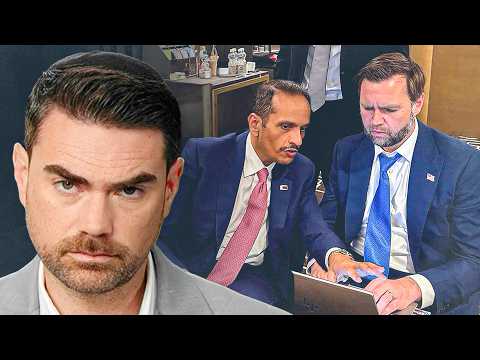
The Iranian delegation refused a planned joint photo opportunity with the US delegation, and later walked through the press room without acknowledging the Vice President, signaling a deliberate snub. This protocol breach, coupled with Iran's refusal to shake hands, underscores a strategy to publicly diminish the United States' standing during sensitive negotiations.
Shapiro Slams 'Deconfliction Mechanism' as Iranian Proxy Play
Ben Shapiro vehemently criticizes the 'deconfliction mechanism' for Lebanon and Israel, brokered by VP Vance, arguing it's a sham. He points out that the mechanism includes Qatar and Pakistan, which he labels as 'Iranian cutouts,' and excludes Israel, the actual party involved. Shapiro dismisses Vance's explanation of a 'junior guy' firing a drone as naive, suggesting Iran is exploiting perceived American weakness to advance its agenda, including controlling the Strait of Hormuz and supporting terrorism.
President Trump signed the memorandum of understanding with Iran primarily due to economic calculations and concerns about the upcoming midterm elections, believing that lower oil prices and economic stability would benefit his party. This pragmatic approach, prioritizing short-term economic gains over a potentially stronger stance against Iran, is a key driver behind the deal.
The Optics of Weakness
Despite a significant military victory against Iran, the signing of the MOU creates poor optics, making the United States appear weak and allowing an Islamic tyranny to dictate terms. This undermines America's global standing and sends a dangerous signal to adversaries like China and Russia, suggesting that aggression can yield concessions.
The Danger of a Full Deal
If the MOU were to evolve into a full agreement, it would be a disaster, granting Iran permanent control over the Strait of Hormuz, substantial financial resources for developing nuclear weapons and funding terrorism, and weakening the global order by signaling that adversaries can dictate terms to the US.