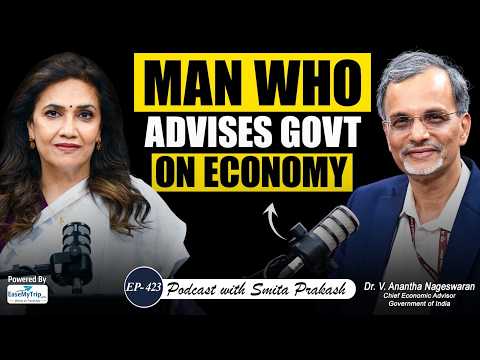





































GDP, AI, China, Inflation, Jobs & Rupee | India's Chief Economic Advisor V Anantha Nageswaran |EP423
Foreign Investment vs. Domestic Investors
Nageswaran clarifies that tax exemptions for foreign portfolio investors (FPIs) in sovereign bonds are based on residence-based taxation, a common international practice. He argues this is not about subsidizing foreign capital but ensuring a level playing field, as non-residents lack other domestic tax liabilities. He points to domestic tax reliefs and slab widenings as evidence of the government's evenhanded approach to taxpayers.
Nageshwaran: GDP Statistics Are Reliable
V. Anantha Nageswaran asserts that India's GDP statistics are reliable, adhering to internationally accepted methods and avoiding artificial inflation of numbers. He contrasts India's approach with other countries that might use methodological revisions to boost figures, stating India's conservatism in GDP reporting. He argues that critiques often stem from prior expectations not being met by the data, leading to distrust.
India's Resilience vs. Linear Projections
Skeptics underestimate India's resilience and adaptability, extrapolating linearly from past data. India's economy, as a complex system within a democracy, defies simple linear projections, confounding both optimists and pessimists.
Manufacturing Competitiveness: Skilling, Energy, Land
To boost manufacturing, India must address input costs: improve skilling (trade skills are crucial and AI-resistant), lower energy costs for industry, and reform land regulations by increasing floor area ratios to encourage vertical construction and efficient land use.
Welfare Measures: Affordability and Design
Welfare expenditure is a democratic obligation, but its effectiveness hinges on affordability and design. Instead of open-ended freebies, benefits should be conditional, enhancing population quality (e.g., linking aid to children's education or skill acquisition) and targeting those genuinely needing support to compete.
Trade Skills: The Future of Employability
The era favoring software and MBA education is waning; future employability lies in trade skills (welding, plumbing, carpentry) and soft skills (counseling, culinary arts) that AI cannot easily replicate. These skills offer respectability and long-term career prospects, unlike many AI-vulnerable professions.
AI: Hype vs. Reality
The current narrative surrounding AI's impact on the labor market is largely driven by hype, fueled by companies seeking capital. While AI will automate some tasks and displace certain jobs, it is unlikely to be the massive disruptor feared. Instead, AI can augment human capabilities, increase productivity, and create new opportunities, particularly for those who can adapt and acquire relevant skills. The true impact will become clearer once the current market bubble bursts and AI services are priced more realistically.
AI as a Productivity Enhancer
AI's true potential lies in its ability to enhance human productivity and capabilities, rather than replace workers entirely. Examples like radiology, where AI tools have increased radiologist efficiency and value, demonstrate this. Similarly, in academia, AI can be a powerful tool for research and analysis, provided individuals know how to ask the right questions. This requires continuous learning and reading to effectively leverage AI.
V. Anantha Nageswaran: The Myth of Middle-Class Dissatisfaction
The perceived restlessness of India's middle class is not an indicator of stagnation but a natural consequence of rising aspirations. While pre-liberalization India faced scarcity and long waiting lists for basic goods, post-liberalization has brought instant availability, yet human nature dictates that fulfilled desires are quickly replaced by new, higher aspirations, creating a perpetual gap that fuels this 'restlessness'. This indicates progress, not decline.
V. Anantha Nageswaran: The Unfinished Agenda
Despite significant progress, India faces an 'unfinished agenda' due to its size and aspirations. While basic needs like food security are met, challenges in areas like energy security, import dependence for critical goods (pharma, fertilizers), and urban quality of life persist. The key is balancing pride in achievements with a clear-eyed view of the remaining journey.
V. Anantha Nageswaran: Addressing Wealth Creator Exodus
The departure of some Indian billionaires is a complex phenomenon, not solely indicative of a lack of confidence in the government or India's future. Reasons can include third-generation business succession issues, global opportunities, and the inherent complexities of managing large enterprises. Attributing it solely to a negative outlook is an oversimplification; many factors are at play, and the narrative needs comparative perspective against those returning or staying.
Long-Term Reforms: Education, Health, and Justice
Crucial reforms in areas like skilling, education, health, administrative processes, and judicial efficiency require long-term commitment and will only show results over years or decades. While immediate impacts from energy or semiconductor initiatives are visible, foundational changes in these sectors are essential for sustained future development, even if their payoff isn't immediate.
Competitive Federalism and Delivery Impatience
India's competitive federal structure, where states vie for funds and investment, is heartening. However, a global trend of impatience with governments, demanding rapid delivery within short political cycles, clashes with the long-term nature of development. This creates a challenge for political parties needing to balance immediate demands with strategic, long-term planning.
Evolving Views on Government vs. Markets
V. Anantha Nageswaran reflects on how his views on the role of government and markets have evolved. Initially, influenced by the Reagan-Thatcher era, he leaned towards the idea that governments are often the source of problems and that markets can solve issues. However, through experience, he realized that markets can also create problems, making governments indispensable. He now advocates for a context-driven approach, advising against adhering to rigid labels like 'free market' or 'development economist,' and instead suggests letting the situation dictate the answer. The final sentence is: This evolution underscores a pragmatic shift from ideological purity to situational responsiveness in economic policy.
The 'Brain Gain' Perspective
V. Anantha Nageswaran views the return of skilled Indians not as a 'brain drain' reversal but as a 'brain gain' or contribution from an 'intellectual bank.' He emphasizes that individuals should not be judged negatively for choosing to live abroad, as they contribute in various ways, including remittances and intellectual input. He advocates for welcoming and facilitating the contributions of Indians living overseas, whether they return permanently or temporarily, without imposing idealistic expectations. The final sentence is: This inclusive approach recognizes the diverse ways in which the Indian diaspora can contribute to the nation's progress. He himself spent 22 years in Singapore before returning to India.
Navigating Criticism and Misinformation
V. Anantha Nageswaran believes in being selective when responding to criticism, particularly distinguishing between motivated opinions and substantive empirical or conceptual points. He argues that engaging with criticism is important when it presents factual inaccuracies or one-sided perspectives that gain undue momentum, citing his response to an article questioning India's AI capabilities. However, he also acknowledges the overwhelming volume of opinions in the social media age, suggesting that not all criticisms warrant a direct counter-response. The final sentence is: The strategy involves a judicious balance between defending factual integrity and allowing diverse perspectives to coexist.