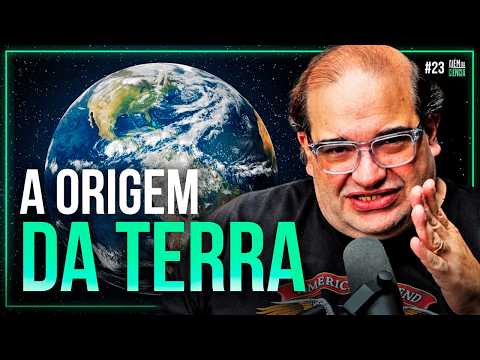





































SACANI RESPONDE: A ORIGEM DA TERRA (TUDO QUE ACONTECEU EM 4,5 BILHÕES DE ANOS) | Além da Ciência #23
The Birth of Our Solar System
Around 4.6 billion years ago, a giant cloud of gas and dust collapsed under its own gravity, likely triggered by a nearby supernova. This collapse led to the formation of the Sun at the center and a protoplanetary disk around it. Within this disk, dust particles accreted into planetesimals, which then collided and merged to form the planets, including proto-Earth.
Earth's Fiery Birth and Solidifying Crust
The early Earth was a molten, chaotic sphere that gradually cooled, allowing the first solid crust to form. Evidence for this ancient period includes microscopic zircon crystals dated to 4.4 billion years ago, representing the oldest known piece of Earth.
The Toxic Atmosphere and the Mystery of Water
Earth's primitive atmosphere was a toxic mix of CO2, methane, and ammonia, devoid of oxygen. The origin of water remains a significant question, with theories suggesting delivery via meteorites, comets, and icy asteroids during the intense bombardment period between 4.1 and 3.8 billion years ago.
Resurfacing: Earth's Dynamic Erasure of Impact History
Unlike the Moon, Earth's surface is constantly renewed by tectonic activity and erosion, a process called 'resurfacing.' This dynamic geological activity erases most impact craters, unlike the Moon's static surface which preserves them, making Earth's ancient impact history harder to decipher.
The Rapid Emergence of Life: LUCA's Timeline
Recent studies suggest LUCA, the Last Universal Common Ancestor, lived around 4.2 billion years ago, surprisingly soon after Earth's formation. This implies life may have arisen quickly once conditions became favorable, potentially increasing the probability of life elsewhere in the universe.
Stromatolites: Ancient Microbial Architects of Rock
Stromatolites, layered rocks formed by ancient microorganisms, provide unequivocal evidence of early life, dating back to 3.5 billion years ago. These structures, still found today, are crucial for understanding Earth's biological past and are sought after on other planets like Mars.
The Great Oxygenation Event: A Poisonous Revolution
Around 2.4 billion years ago, cyanobacteria began producing oxygen through photosynthesis. Initially toxic to most life, this oxygen reacted with iron, forming vast ore deposits, before accumulating in the atmosphere, triggering a mass extinction of anaerobic life and potentially initiating the 'Snowball Earth' periods.
The Cambrian Explosion: A Burst of Biodiversity
Around 541 million years ago, the Cambrian Explosion saw the rapid appearance of most major animal phyla. This event, likely driven by increased oxygen levels, evolutionary arms races, and geochemical changes, marked a dramatic diversification of life, equivalent to a biological Big Bang.
The Carboniferous Period: Forests and Fossil Fuels
The Carboniferous period (358-298 million years ago) was dominated by vast forests whose decaying matter formed the coal and oil reserves we use today. Atmospheric oxygen levels soared, allowing for giant insects, and the decomposition of this carbon-rich vegetation fundamentally shaped Earth's geology and energy resources.
The Permian-Triassic Extinction: Life's Near Annihilation
The Permian-Triassic extinction event, 252 million years ago, wiped out 96% of marine and 70% of terrestrial species, likely caused by massive volcanic activity. This cataclysm drastically reshaped life on Earth, paving the way for new forms to evolve.
The K-Pg Extinction: Asteroid Impact and Dinosaur Demise
A 10 km asteroid impact 66 million years ago, creating the Chicxulub crater, caused the K-Pg extinction, eliminating non-avian dinosaurs and 75% of species. This event allowed mammals and birds (avian dinosaurs) to diversify and eventually dominate the planet.
The Rise of Mammals and Early Hominins
Following the K-Pg extinction, mammals inherited the Earth, diversifying rapidly. This era saw the emergence of primates, the split of the hominid lineage, and the appearance of early hominins like Lucy (Australopithecus afarensis) and Homo habilis, who began using stone tools.
The Cognitive Revolution: A Leap in Human Potential
Around 70,000 years ago, the Cognitive Revolution marked a significant shift in human capabilities, enabling complex language, abstract thought, and large-scale cooperation, which profoundly shaped human history and our place on Earth.
The Cognitive Revolution: A Leap in Human Evolution
Around 70,000 years ago, a cognitive revolution occurred, enabling Homo sapiens to develop art, music, and complex language. This allowed for greater cooperation and migration out of Africa, fundamentally altering human history and paving the way for civilization.
The Sixth Mass Extinction: Humanity's Role
Current species extinction rates are 100 to 1000 times faster than natural rates, leading scientists to label it the sixth mass extinction. This event, unlike previous ones, is primarily caused by intelligent species—humans—through activities like CO2 and plastic production, threatening our own survival.
The Cosmic Connection: We Are Stardust
Every atom in our bodies originated from stars that lived and died billions of years ago. This cosmic heritage means we are intrinsically connected to the universe, a transient pathway for atoms traveling between stars and planets, underscoring Earth's unique status as a known haven for life.