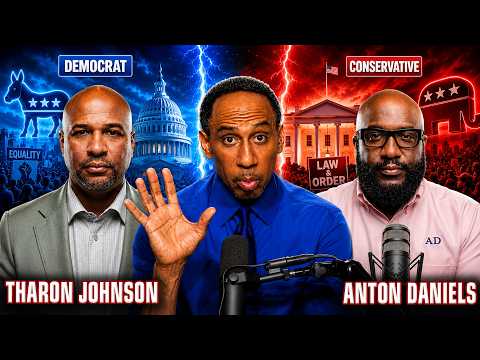
Tharon Johnson argues that while personal responsibility is important, systemic barriers, lack of leadership, and policy failures, particularly from federal administrations like Trump's, have significantly impacted Black America. He emphasizes the need for investment in public schools, quality jobs, and healthcare, and for holding elected officials accountable for delivering on promises.
Daniels: No Inequities, Just Lack of Discipline
Anton Daniels refutes the notion of systemic inequities, stating he hasn't experienced them and highlighting immigrants who succeed with nothing. He attributes the struggles of Black communities to a lack of discipline, poor decision-making in education and career choices (e.g., avoiding STEM fields), and a failure to learn from history, arguing that external blame prevents progress.
Daniels: Detroit's Fiscal Collapse and Leadership Failures
Anton Daniels points to Detroit's history of bankruptcy under Black leadership (Kilpatrick, Young) as evidence that identity politics doesn't guarantee good governance. He credits Mayor Mike Duggan and business leaders for the city's subsequent recovery and surplus, arguing that effective leadership and business acumen, not race, are key to success.
Johnson: Personal Work vs. Partisan Criticism
Tharon Johnson counters Anton Daniels, describing him as 'disillusioned' and using conservatism for 'elitism.' Johnson details his own extensive community work (HBCUs, TSA workers, re-entry programs) to demonstrate genuine effort, contrasting it with Daniels' perceived focus on viral, controversial topics. He asserts that Daniels' conservatism is unproductive for the Black community.
Johnson: Democrats' Credit and Governing Challenges
Tharon Johnson argues Democrats deserve credit for Black progress, citing lower black unemployment rates under Democratic administrations. He acknowledges the need to reward voters with positions of power and offer solutions, emphasizing that governing requires working with all communities while keeping Black advancement at the core.
Daniels: Democrats' Lack of Accountability & Wealth Gap
Anton Daniels challenges Tharon Johnson's claim of Democratic success, arguing the party doesn't take responsibility for Black America's struggles, which he believes are worse than ever. He states Republicans aim to remove barriers for self-sufficiency, not provide handouts, and criticizes the focus on public sector jobs over private sector competitiveness.
Johnson: Trump's Government Cuts & Economic Impact
Tharon Johnson criticizes Donald Trump's administration for laying off federal workers, disproportionately affecting Black women, and argues the response to 'go into the corporate sector' was illogical. He contrasts this with Democratic efforts, suggesting Trump's policies and rhetoric on shrinking government, despite campaign promises, led to negative economic consequences like high inflation.
Daniels: Government Audits & Evolving Needs
Anton Daniels defends the idea of government audits and removing subsidies for private jobs, stating layoffs happen regularly in the private sector. He argues that government departments, like Education, should be returned to states and that teaching methods must evolve, especially with AI, to address learning disabilities and prepare students for the modern workforce.
Immigration's Impact on Black Communities
Tharon Johnson acknowledges concerns within the Black community about job competition from immigrants but emphasizes the need to address the undocumented population already present, suggesting pathways to work permits and citizenship for those who are productive. Anton Daniels strongly criticizes the current immigration policies, arguing that illegal immigration diverts resources from citizens, undermines the rule of law, and that the Democratic party takes Black votes for granted by prioritizing immigrant populations. He also questions the concept of birthright citizenship, viewing it as exploited by illegal migrants.
Johnson on Crime and De-escalation
Tharon Johnson attributes rising crime rates to a lack of job opportunities, poor parental environments, and a societal failure to de-escalate conflicts, leading to increased gun violence. He advocates for responsible gun ownership, better access to jobs, and improved community policing and technology to solve crimes. Johnson emphasizes that crime is an 'American problem' affecting all communities, not just Black ones, and calls for addressing the root causes of desperation and violence.
Daniels on Persistent Problems in Black Communities
Anton Daniels argues that persistent issues in predominantly Black neighborhoods, such as violence, failing schools, and poverty, are primarily due to a lack of personal responsibility and the Democratic party's failure to deliver on promises. He criticizes Chicago Mayor Brandon Johnson's 'defund the police' stance and the removal of crime-fighting technology, suggesting these actions have led to a loss of control and trust within the police department. Daniels believes these problems are exacerbated by policies that do not hold individuals accountable.
Johnson: Addressing Root Causes is Key
Tharon Johnson counters that true progress for Black Americans requires addressing the root causes of issues, which he identifies as poverty and access to quality education. He advocates for robust support of public schools and emphasizes the need for responsible gun ownership and addressing mental illness. Johnson believes that focusing solely on crime without tackling these underlying societal problems is insufficient and that a more holistic approach is needed for genuine improvement.
Smith: Personal Accountability in Family Structure
Stephen A. Smith shares a personal reflection on his own past mistakes, specifically having children out of wedlock, which disappointed his mother. He validates Johnson and Daniels' points about the importance of family structure, acknowledging that deviating from this premise makes life significantly harder. Smith emphasizes authenticity and the difficulty of building from a less stable foundation, reinforcing the idea that strong family units are crucial for success.